Paradox and the Hope of Progress

by Elizabeth

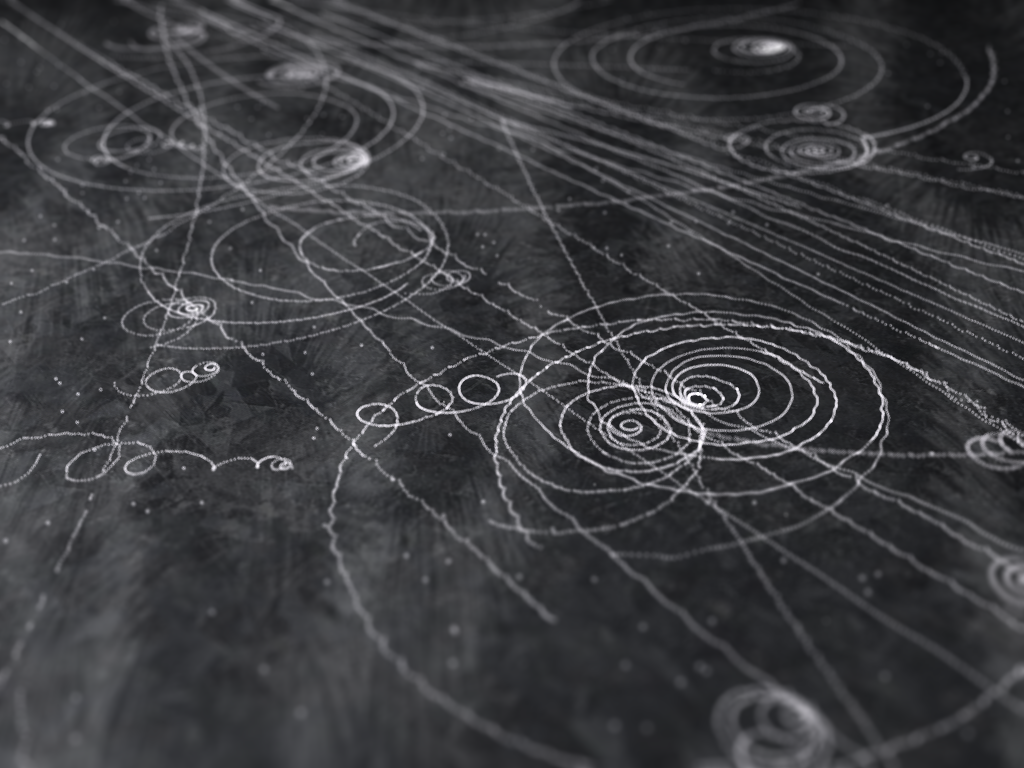
The paths of subatomic particles in a bubble chamber.

The paths of subatomic particles in a bubble chamber. Photo source: CERN

A few months ago I came across the phrase “No paradox, no progress” in a science magazine. The quote was attributed to quantum physicist Niels Bohr and immediately grabbed my attention. (Bohr made breakthroughs in understanding the structure of atoms, among other things.) No paradox, no progress?? This statement is as true of quantum mechanics as it is of life.

The phrase really stuck with me and came to mind as I was writing my last installment in the Parsonage Heresies series at A Life Overseas. I didn’t have space in the article to contemplate this beautiful quote the way I wanted to. And at any rate, I couldn’t remember in which article I had found the words “no paradox, no progress,” so I let the idea go. Until now.

When I went searching for the quote in the Place Where All Lost Quotes Reside (also known as The Internet), I discovered that Bohr’s actual words were more akin to “How wonderful that we have met with a paradox. Now we have some hope of making progress.” I love the sentiment from this scientist: we need to give ourselves permission to embrace paradox.

Paradox, that discomfiting feeling we experience when opposites happen at once. Paradox is living in a place where it smells so bad and smells so good all at the same time. Paradox is feeling hope and despair in the same moment. Sometimes we struggle when we cannot reconcile our contradictory facts and feelings, or, in the arena of theology, reconcile seemingly contradictory Biblical passages.

We Western Christians are not very good at making peace with Paradox, are we? Yet without Paradox, our faith gets stuck. Without Paradox, we cling so tightly to our confusion and our contradictions that we can’t move forward in life.

I’ve found that it’s easier in the end — though definitely not in the beginning — to simply accept the paradox of two seemingly opposing truths than to attempt to force them into one truth and lose my faith. It’s better to accept both the good and bad in life and within myself rather than rationalizing any of it away.  After all, Niels Bohr is also quoted as having said “The opposite of a profound truth is another profound truth.”

Bohr’s kind of thinking has strengthened my love for God (He’s so much bigger than I could imagine!) and enriched my study of the Bible (I don’t have to understand it all!). It’s illuminated my past and enabled me to offer grace more fully to other people. I think the more liturgical among us call Bohr’s motto “Mystery.”

Mystery is holding two truths together lightly in our imperfect, human hands, and releasing the need to have one Perfect Answer. Mystery is the reason I’m troubled by extremist theology. Why is it so hard for us, in a trusting embrace of the Father, to hold two truths at the same time? Why can we not hold both that God is mercy, and that He is justice? Why can we not hold both that God is sovereign, and that we have free will (because He gave it to us)?

This Mystery I speak of, it consoles me.  I don’t have to have all the answers. I don’t have to get it all right. I can still believe. Mystery: it’s such a comfort. And in the words of Laura Hackett Park below, what Mystery can give back to us is a Life Abundant.


Now love’s a choice I know it’s true

He never forced my heart to move

But therein lies the mystery

That He reached first in choosing me

He spoke my name the sweetest sound

And to this day I still resound

Now death has lost its hold on me

Now life springs up abundantly

The Heavens Declare

by Elizabeth

apolloearthThe well-known United States/Soviet Union “Space Race” overshadowed a contemporaneous Cold War competition to cut through the Earth’s crust and reach the mantle. The United States abandoned its attempts to drill through the Pacific seafloor — under 11,000 feet of ocean water — after only 5 years and 601 feet. Meanwhile, Soviet drilling tenacity outlived the Soviet Union itself, continuing 24 years from its inception in 1970 to its abandonment in 1994.

Temperatures at the bottom of the Kola hole in northwestern Russia exceeded 300 degrees Fahrenheit. The rocks there were so “plastic” that whenever the drill was withdrawn, the hole would start to close. Their eventual depth reached 7.6 miles, halfway to the mantle and deeper into the Earth’s crust than Mount Everest stands above it — but still minuscule in comparison to Earth’s 7,918-mile diameter.

I never knew any of these fascinating historical tidbits.

I also never considered the fact that although we can see into outer space, we can’t see all the way to the center of the Earth. Our planet poses a problem for scientists: we can’t see into it. The methods we have for “seeing” inside the Earth are limited; everything we know about the bowels of our own planet has been discovered remotely.

I found this information in the July/August 2014 edition of Discover Magazine, in an article by Tim Folger. How we came to understand that Earth has a solid inner core and liquid outer core (in contrast to the liquid-only core scientists had previously believed Earth to have) was particularly intriguing to me, as the discovery was made by female seismologist Inge Lehman. It was a woman who, in 1929, discovered evidence of a solid iron core. It was a woman who, in 1936, published her paper arguing for that solid inner core. And it was a woman who had to wait until 1970 to be proven correct, when instruments were finally sensitive enough to corroborate her claims.

The article goes on to discuss the uniqueness of our magnetic field, especially considering new research into the heat transfer properties of molten iron, whose heat conductivity is higher than previously thought. Recent calculations with these updated properties indicate that the outer core would have conducted too much of its initial heat to the mantle, leaving it too little heat to remain molten. And Earth needs that molten iron core in order to create our life-sustaining magnetic field. Molten iron in the core is what produces the convection currents that power our magnetic field and protect us from cosmic and solar radiation. (This phenomenon is known as a “geodynamo.”)

So where did the heat come from that keeps our outer core molten? In light of the new calculations, scientists have had to look elsewhere for sources of heat for a molten outer core. One of those heat sources is a possible collision between Earth and a Mars-size body, whose blast particles would eventually coalesce into our moon. In that case, seemingly unrelated aspects of life on Earth might not be so unrelated: our moon, a molten core that induces our magnetic field and protects our oxygenated atmosphere from being stripped away, water in the crust that allows for tectonic plates to slip past each other, thus releasing heat from inside the Earth, thereby cooling it and allowing the conduction and convection that makes the molten, moving iron core induce our magnetic field to begin with.

Coincidences? the article’s author asks. Or not? Perhaps a habitable planet requires more than we’ve previously thought necessary. How repeatable is our Earth? We now know that planets are commonplace occurrences, true. But is there now more that needs to happen to ensure life than we used to think? One interviewed scientist said he thinks “It’s a matter of chance, just how the game played out, how the dice were thrown.”

I disagree. It doesn’t matter though. I still find God in the pages of a science magazine. I don’t have to be afraid of the worldview of a science writer. God can be found in the heavens He created, whether or not any researchers believe in Him. He is still there. He is still able to be found. He is still able to be worshiped.

May we daily go forth and find God in the world He has created for us.

_

Photo source: Earth as seen from the Apollo 17 mission

Romance, Science Fiction, and Missions (or, I Dreamed a Dream)

I’m writing over at A Life Overseas today. Here’s a preview…

~Elizabeth

dream God's dreamsI

What motivated you to go into missions? What keeps you going?

Romance. I don’t know about you, but romance is what drove me into missions. The romance of being a great missionary, of changing an entire people group, of seeing a whole country turn to Christ. This romantic idea was first kindled during my children’s homeschool studies of St. Patrick — the man in the 5th century AD who took the Gospel to Ireland, where practically everyone turned from paganism to Christ.

This dream of mine was further fueled when I learned about one of our organization’s church planting teams in South America. Churches have been planted that have grown to membership in the thousands. Those churches have planted other churches. Those churches have even sent out missionaries themselves. When I first heard of this field, I thought Cambodia was going to be just like that. Woo hoo!

Keep reading here.